- Products and Solutions
- Industry Solutions
- Services
- Support
- Training & Certification
- Partners
- About Us
- Contact Sales
- Become a Partner
-
 Login
Login
Country / Region
 Products and SolutionsInterConnectApplication-Driven Wide Area Network (AD-WAN)Flagship ProductsSoftware ProductsH3C Application-Driven WAN Branch Solution
H3C Application-Driven WAN Branch Solution
Independent of application systems, traditional WAN branches were primarily managed from the perspective of network nodes instead of applications. Without visibility into applications, a traditional WAN could hardly adapt to accelerated application provisioning and business changes driven by new technologies such as cloud computing and mobile Internet.
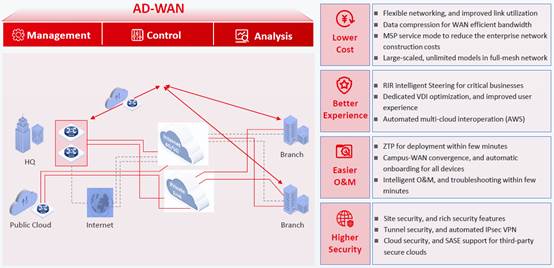
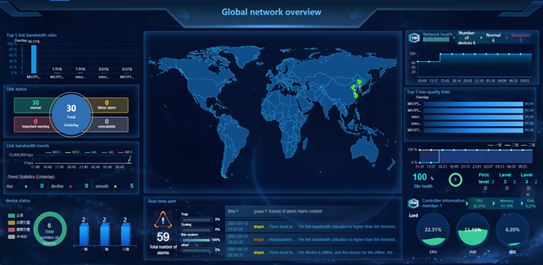
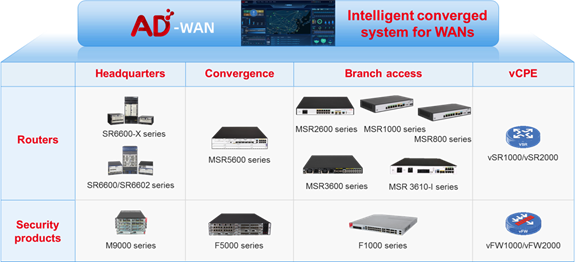
H3C Application-Driven WAN (AD-WAN) is a unified, layered, open, and intelligent architecture. Unifying the intelligent analytics module, intelligent control module, and intelligent management module, AD-WAN enables not only network wide unified network management, control, and analytics, but also provides a user-oriented, unified portal for end-to-end orchestration and unified service orchestration across networks. Based on the big data analysis and AI learning capabilities, AD-WAN captures real-time snapshots of the network and sets up a model offline to implement intelligent visibility, intelligent simulation, and intelligent troubleshooting for the network. AD-WAN helps enterprises to upgrade intelligence for digital networks.
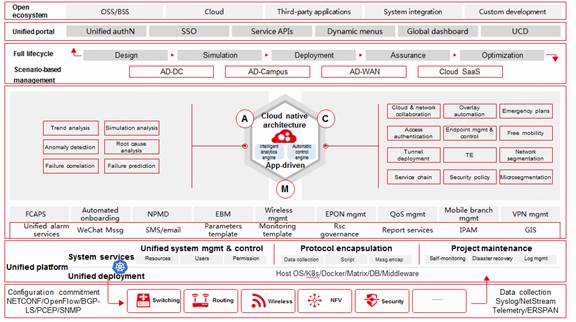
AD-WAN architecture
The solution uses a layered architecture that contains the following layers, from the bottom up:
Infrastructure layer—The network devices can communicate with the control layer through SNMP, NETCONF, NetStream, and CLI. This layer uses VXLAN and IPsec to enable secured data forwarding on the overlay network, and uses RIP to implement intelligent, reliable, and automated traffic engineering on devices.
Control and analytics layer—The intelligent analytics module provides capabilities such as in-depth network analytics and visualization, network traffic prediction, security warning, and fault location. The intelligent control module provides centralized network resource management, control, and optimization. U-Center can integrate with multiple network applications and implement cross-scenario orchestration to meet the needs of users in different industries. This layer uses standard southbound protocols to communicate with the infrastructure layer and uses programmable northbound APIs to communicate the management and orchestration layer for integration with third-party application systems.
Management orchestration layer—This layer calls the APIs provided by U-Center to orchestrate services, define and enforce policies, monitor the network, visualize data, and maintain the network.
The following contents are complex, and it is recommended to browse on PC.

Enter c.h3c.com.cn on the PC browser and operate according to the page to synchronize to the PC and continue browsing.
Continue by mobile