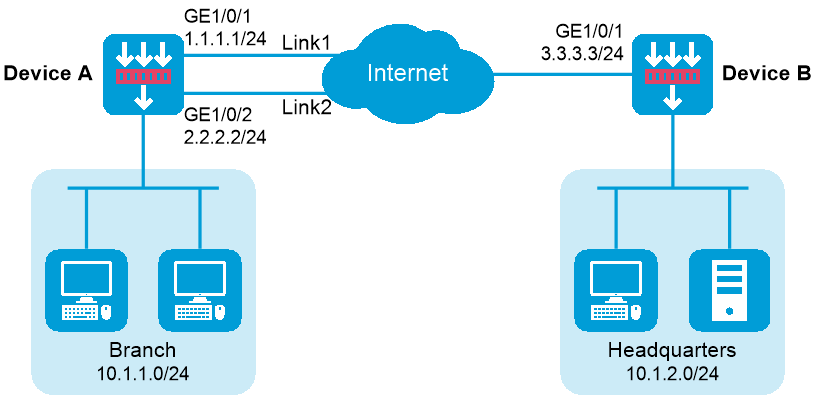
As shown in Figure 1, Device A acts the IPsec gateway of the branch. Device B is the IPsec gateway of the headquarters. Configure IPsec smart link selection so the branch can establish an IPsec tunnel to the headquarters over link 1 or link 2, whichever has a better link quality.
Device A first uses link 1 to establish the IPsec tunnel.
When link 1 suffers high packet loss ratio or delay, Device A automatically switches traffic to the IPsec tunnel established based on link 2.
This configuration example was created and verified on E8371 of the F5000-AI160 device.
1. Configure the IP addresses and gateway addresses for GigabitEthernet 1/0/1 and GigabitEthernet 1/0/2:
# Configure an IP address for GigabitEthernet 1/0/1 and specify the gateway address for the interface. This example uses 1.1.1.3 as the gateway address.
<DeviceA> system-view
[DeviceA] interface gigabitethernet 1/0/1
[DeviceA-GigabitEthernet1/0/1] ip address 1.1.1.1 24
[DeviceA-GigabitEthernet1/0/1] gateway 1.1.1.3
[DeviceA-GigabitEthernet1/0/1] quit
# Configure an IP address for GigabitEthernet 1/0/2 and specify the gateway address for the interface. This example uses 2.2.2.3 as the gateway address.
[DeviceA] interface gigabitethernet 1/0/2
[DeviceA-GigabitEthernet1/0/2] ip address 2.2.2.2 24
[DeviceA-GigabitEthernet1/0/2] gateway 2.2.2.3
[DeviceA-GigabitEthernet1/0/2] quit
2. Add interfaces to security zones.
[DeviceA] security-zone name trust
[DeviceA-security-zone-Trust] import interface gigabitethernet 1/0/3
[DeviceA-security-zone-Trust] quit
[DeviceA] security-zone name untrust
[DeviceA-security-zone-Untrust] import interface gigabitethernet 1/0/1
[DeviceA-security-zone-Untrust] import interface gigabitethernet 1/0/2
[DeviceA-security-zone-Untrust] quit
3. Configure a security policy:
Configure rules to permit traffic between the Untrust and Local security zones, so the devices can set up an IPsec tunnel:
# Configure a rule named ipseclocalout to allow Device A to send IPsec negotiation packets to Device B.
[DeviceA] security-policy ip
[DeviceA-security-policy-ip] rule name ipseclocalout
[DeviceA-security-policy-ip-1-ipseclocalout] source-zone local
[DeviceA-security-policy-ip-1-ipseclocalout] destination-zone untrust
[DeviceA-security-policy-ip-1-ipseclocalout] source-ip-host 1.1.1.1
[DeviceA-security-policy-ip-1-ipseclocalout] source-ip-host 2.2.2.2
[DeviceA-security-policy-ip-1-ipseclocalout] destination-ip-host 3.3.3.3
[DeviceA-security-policy-ip-1-ipseclocalout] action pass
[DeviceA-security-policy-ip-1-ipseclocalout] quit
# Configure a rule named ipseclocalin to allow Device A to receive the IPsec negotiation packets sent from Device B.
[DeviceA-security-policy-ip] rule name ipseclocalin
[DeviceA-security-policy-ip-2-ipseclocalin] source-zone untrust
[DeviceA-security-policy-ip-2-ipseclocalin] destination-zone local
[DeviceA-security-policy-ip-2-ipseclocalin] source-ip-host 3.3.3.3
[DeviceA-security-policy-ip-2-ipseclocalin] destination-ip-host 1.1.1.1
[DeviceA-security-policy-ip-2-ipseclocalin] destination-ip-host 2.2.2.2
[DeviceA-security-policy-ip-2-ipseclocalin] action pass
[DeviceA-security-policy-ip-2-ipseclocalin] quit
Configure rules to permit the traffic between Host A and Host B:
# Configure a rule named trust-untrust to permit the packets from Host A to Host B.
[DeviceA-security-policy-ip] rule name trust-untrust
[DeviceA-security-policy-ip-3-trust-untrust] source-zone trust
[DeviceA-security-policy-ip-3-trust-untrust] destination-zone untrust
[DeviceA-security-policy-ip-3-trust-untrust] source-ip-subnet 10.1.1.0 24
[DeviceA-security-policy-ip-3-trust-untrust] destination-ip-subnet 10.1.2.0 24
[DeviceA-security-policy-ip-3-trust-untrust] action pass
[DeviceA-security-policy-ip-3-trust-untrust] quit
# Configure a rule named untrust-trust to permit the packets from Host B to Host A.
[DeviceA-security-policy-ip] rule name untrust-trust
[DeviceA-security-policy-ip-4-untrust-trust] source-zone untrust
[DeviceA-security-policy-ip-4-untrust-trust] destination-zone trust
[DeviceA-security-policy-ip-4-untrust-trust] source-ip-subnet 10.1.2.0 24
[DeviceA-security-policy-ip-4-untrust-trust] destination-ip-subnet 10.1.1.0 24
[DeviceA-security-policy-ip-4-untrust-trust] action pass
[DeviceA-security-policy-ip-4-untrust-trust] quit
[DeviceA-security-policy-ip] quit
4. Configure an IPsec smart link policy, so that the device can select a qualified link to establish an IPsec tunnel with the headquarters.
[DeviceA] ipsec smart-link policy policy1
[DeviceA-ipsec-smart-link-policy-policy1] link 1 interface gigabitethernet 1/0/1 remote 3.3.3.3
[DeviceA-ipsec-smart-link-policy-policy1] link 2 interface gigabitethernet 1/0/2 remote 3.3.3.3
[DeviceA-ipsec-smart-link-policy-policy1] link-switch cycles 4
[DeviceA-ipsec-smart-link-policy-policy1] smart-link enable
[DeviceA-ipsec-smart-link-policy-policy1] quit
5. Configure an ACL to define the data flows to be protected by IPsec.
[DeviceA] acl advanced 3000
[DeviceA-acl-ipv4-adv-3000] rule permit ip source 10.1.1.0 0.0.0.255 destination 10.1.2.0 0.0.0.255
[DeviceA-acl-ipv4-adv-3000] quit
6. Configure an IPsec transform set to specify the packet encapsulation mode, security protocols, and algorithms.
The IPsec transform set settings at both sides of the IPsec tunnel must be the same.
[DeviceA] ipsec transform-set tran1
[DeviceA-ipsec-transform-set-tran1] encapsulation-mode tunnel
[DeviceA-ipsec-transform-set-tran1] protocol esp
[DeviceA-ipsec-transform-set-tran1] esp encryption-algorithm aes-cbc-128
[DeviceA-ipsec-transform-set-tran1] esp authentication-algorithm sha1
[DeviceA-ipsec-transform-set-tran1] quit
7. Configure an IKE keychain to specify the key information used for IKE communication.
The preshared key used by both sides of the communication must be the same.
[DeviceA] ike keychain keychain1
[DeviceA-ike-keychain-keychain1] pre-shared-key address 3.3.3.3 24 key simple 123456
[DeviceA-ike-keychain-keychain1] quit
8. Configure an IKE profile to specify the security parameters used for setting up IKE SAs.
[DeviceA] ike profile profile1
[DeviceA-ike-profile-profile1] keychain keychain1
[DeviceA-ike-profile-profile1] match remote identity address 3.3.3.3 24
[DeviceA-ike-profile-profile1] quit
9. Configure an IPsec policy, so as to establish the IPsec tunnel to protect data.
[DeviceA] ipsec policy policy1 10 isakmp
[DeviceA-ipsec-policy-isakmp-policy1-10] security acl 3000
[DeviceA-ipsec-policy-isakmp-policy1-10] transform-set tran1
[DeviceA-ipsec-policy-isakmp-policy1-10] ike-profile profile1
[DeviceA-ipsec-policy-isakmp-policy1-10] smart-link policy policy1
[DeviceA-ipsec-policy-isakmp-policy1-10] quit
1. Assign an IP address to interface GigabitEthernet 1/0/1, and configure the gateway address. In this example, the gateway address is the direct next hop address 3.3.3.4.
<DeviceB> system-view
[DeviceB] interface gigabitethernet 1/0/1
[DeviceB-GigabitEthernet1/0/1] ip address 3.3.3.3 24
[DeviceB-GigabitEthernet1/0/1] gateway 3.3.3.4
[DeviceB-GigabitEthernet1/0/1] quit
2. Add interfaces to security zones.
[DeviceB] security-zone name trust
[DeviceB-security-zone-Trust] import interface gigabitethernet 1/0/2
[DeviceB-security-zone-Trust] quit
[DeviceB] security-zone name untrust
[DeviceB-security-zone-Untrust] import interface gigabitethernet 1/0/1
[DeviceB-security-zone-Untrust] quit
3. Configure a security policy:
Configure rules to permit traffic between the Untrust and Local security zones, so the devices can set up an IPsec tunnel:
# Configure a rule named ipseclocalout to allow Device B to send IPsec negotiation packets to Device A.
[DeviceB] security-policy ip
[DeviceB-security-policy-ip] rule name ipseclocalout
[DeviceB-security-policy-ip-1-ipseclocalout] source-zone local
[DeviceB-security-policy-ip-1-ipseclocalout] destination-zone untrust
[DeviceB-security-policy-ip-1-ipseclocalout] source-ip-host 3.3.3.3
[DeviceB-security-policy-ip-1-ipseclocalout] destination-ip-host 1.1.1.1
[DeviceB-security-policy-ip-1-ipseclocalout] destination-ip-host 2.2.2.2
[DeviceB-security-policy-ip-1-ipseclocalout] action pass
[DeviceB-security-policy-ip-1-ipseclocalout] quit
# Configure a rule named ipseclocalin to allow Device B to receive the IPsec negotiation packets sent from Device A.
[DeviceB-security-policy-ip] rule name ipseclocalin
[DeviceB-security-policy-ip-2-ipseclocalin] source-zone untrust
[DeviceB-security-policy-ip-2-ipseclocalin] destination-zone local
[DeviceB-security-policy-ip-2-ipseclocalin] source-ip-host 1.1.1.1
[DeviceB-security-policy-ip-2-ipseclocalin] source-ip-host 2.2.2.2
[DeviceB-security-policy-ip-2-ipseclocalin] destination-ip-host 3.3.3.3
[DeviceB-security-policy-ip-2-ipseclocalin] action pass
[DeviceB-security-policy-ip-2-ipseclocalin] quit
Configure rules to permit the traffic between Host A and Host B:
# Configure a rule named trust-untrust to permit the packets from Host B to Host A.
[DeviceB-security-policy-ip] rule name trust-untrust
[DeviceB-security-policy-ip-3-trust-untrust] source-zone trust
[DeviceB-security-policy-ip-3-trust-untrust] destination-zone untrust
[DeviceB-security-policy-ip-3-trust-untrust] source-ip-subnet 10.1.2.0 24
[DeviceB-security-policy-ip-3-trust-untrust] destination-ip-subnet 10.1.1.0 24
[DeviceB-security-policy-ip-3-trust-untrust] action pass
[DeviceB-security-policy-ip-3-trust-untrust] quit
# Configure a rule named untrust-trust to permit the packets from Host A to Host B.
[DeviceB-security-policy-ip] rule name untrust-trust
[DeviceB-security-policy-ip-4-untrust-trust] source-zone untrust
[DeviceB-security-policy-ip-4-untrust-trust] destination-zone trust
[DeviceB-security-policy-ip-4-untrust-trust] source-ip-subnet 10.1.1.0 24
[DeviceB-security-policy-ip-4-untrust-trust] destination-ip-subnet 10.1.2.0 24
[DeviceB-security-policy-ip-4-untrust-trust] action pass
[DeviceB-security-policy-ip-4-untrust-trust] quit
[DeviceB-security-policy-ip] quit
4. Configure an ACL to define the data flows to be protected by IPsec.
[DeviceB] acl advanced 3000
[DeviceB-acl-ipv4-adv-3000] rule permit ip source 10.1.2.0 0.0.0.255 destination 10.1.1.0 0.0.0.255
[DeviceB-acl-ipv4-adv-3000] rule permit ip source 3.3.3.0 0.0.0.255 destination 1.1.1.0 0.0.0.255
[DeviceB-acl-ipv4-adv-3000] rule permit ip source 3.3.3.0 0.0.0.255 destination 2.2.2.0 0.0.0.255
[DeviceB-acl-ipv4-adv-3000] quit
5. Configure an IPsec transform set to specify the packet encapsulation mode, security protocols, and algorithms.
The IPsec transform set settings at both sides of the IPsec tunnel must be the same.
[DeviceB] ipsec transform-set tran1
[DeviceB-ipsec-transform-set-tran1] encapsulation-mode tunnel
[DeviceB-ipsec-transform-set-tran1] protocol esp
[DeviceB-ipsec-transform-set-tran1] esp encryption-algorithm aes-cbc-128
[DeviceB-ipsec-transform-set-tran1] esp authentication-algorithm sha1
[DeviceB-ipsec-transform-set-tran1] quit
6. Configure an IKE keychain to specify the key information used for IKE communication.
The preshared key used by both sides of the communication must be the same.
[DeviceB] ike keychain keychain1
[DeviceB-ike-keychain-keychain1] pre-shared-key address 0.0.0.0 0 key simple 123456
[DeviceB-ike-keychain-keychain1] quit
7. Configure an IKE profile to specify the security parameters used for setting up IKE SAs.
[DeviceB] ike profile profile1
[DeviceB-ike-profile-profile1] keychain keychain1
[DeviceB-ike-profile-profile1] match remote identity address 0.0.0.0 0
[DeviceB-ike-profile-profile1] quit
8. Configure an IPsec policy template, which is used to create IPsec policies.
[DeviceB] ipsec policy-template template1 10
[DeviceB-ipsec-policy-template-template1-10] security acl 3000
[DeviceB-ipsec-policy-template-template1-10] transform-set tran1
[DeviceB-ipsec-policy-template-template1-10] local-address 3.3.3.3
[DeviceB-ipsec-policy-template-template1-10] ike-profile profile1
[DeviceB-ipsec-policy-template-template1-10] quit
9. Create an IKE-based IPsec policy by using IPsec policy template template1, so as to establish the IPsec tunnel to proctect data.
[DeviceB] ipsec policy policy1 10 isakmp template template1
10. Apply the IPsec policy to GigabitEthernet 1/0/1 to protect traffic on the interface.
[DeviceB] interface gigabitethernet 1/0/1
[DeviceB-GigabitEthernet1/0/1] ipsec apply policy policy1
[DeviceB-GigabitEthernet1/0/1] quit
# Display IPsec smart link policy information on Device A.
[DeviceA] display ipsec smart-link policy
--------------------------------------------------------------------------
Policy name : policy1
State :Enabled
Probe count :10
Probe interval :1 sec
Probe source IP address :1.1.1.1
Probe destination IP address :3.3.3.3
Max link switch cycles :4
IPsec policy name :policy1
Interface :GigabitEthernet1/0/1
IPsec policy sequence number :10
Link ID Local address Remote address Loss(%) Delay(ms) State
1 1.1.1.1 3.3.3.3 0.0 1.0 Active
2 2.2.2.2 3.3.3.3 25.0 1.0 Inactive(Available)
--------------------------------------------------------------------------
# Display information about the IPsec policy to which IPsec smart link policy policy1 is applied.
[DeviceA] display ipsec policy
-------------------------------------------
IPsec Policy: policy1
Interface: GigabitEthernet1/0/1
-------------------------------------------
-----------------------------
Sequence number: 10
Alias: map1-10
Mode: ISAKMP
-----------------------------
Traffic Flow Confidentiality: Disabled
Security data flow: 3000
Selector mode: standard
Local address: 1.1.1.1
Remote address: 3.3.3.3
Transform set: tran1
IKE profile: profile1
IKEv2 profile:
smart-link policy: policy1
SA trigger mode: Auto
SA duration(time based): 3600 seconds
SA duration(traffic based): 1843200 kilobytes
SA idle time: 100 seconds
# Display the ACL rules in the ACL used by IPsec policy policy1.
[DeviceA] display acl 3000
Advanced IPv4 ACL 3000, 3 rules,
ACL's step is 5
rule 0 permit ip source 10.1.1.0 0.0.0.255 destination 10.1.2.0 0.0.0.255
rule 5 permit ip source 1.1.1.0 0.0.0.255 destination 3.3.3.3 0 (Dynamic) (10 times matched)
The command output shows that an ACL rule (rule 5) is automatically added to permit the link quality probe packets.
# Verify that IPsec SAs are established on Device A.
[DeviceA]display ipsec sa
-------------------------------
Interface: GigabitEthernet1/0/1
-------------------------------
-----------------------------
IPsec policy: policy1
Sequence number: 10
Mode: ISAKMP
-----------------------------
Tunnel id: 0
Encapsulation mode: tunnel
Perfect Forward Secrecy:
Inside VPN:
Extended Sequence Numbers enable: N
Traffic Flow Confidentiality enable: N
Transmitting entity: Initiator
Path MTU: 1428
Tunnel:
local address/port: 1.1.1.1/500
remote address/port: 3.3.3.3/500
Flow:
sour addr: 1.1.1.0/255.255.255.0 port: 0 protocol: ip
dest addr: 3.3.3.3/255.255.255.255 port: 0 protocol: ip
[Inbound ESP SAs]
SPI: 2443816215 (0x91a9ad17)
Connection ID: 38654705665
Transform set: ESP-ENCRYPT-AES-CBC-128 ESP-AUTH-SHA1
SA duration (kilobytes/sec): 1843200/3600
SA remaining duration (kilobytes/sec): 1843194/3368
Max received sequence-number: 64
Anti-replay check enable: Y
Anti-replay window size: 64
UDP encapsulation used for NAT traversal: N
Status: Active
[Outbound ESP SAs]
SPI: 4220315517 (0xfb8ce77d)
Connection ID: 38654705664
Transform set: ESP-ENCRYPT-AES-CBC-128 ESP-AUTH-SHA1
SA duration (kilobytes/sec): 1843200/3600
SA remaining duration (kilobytes/sec): 1843194/3368
Max sent sequence-number: 64
UDP encapsulation used for NAT traversal: N
Status: Active
Device A
#
interface GigabitEthernet1/0/1
ip address 1.1.1.1 255.255.255.0
gateway 1.1.1.3
#
interface GigabitEthernet1/0/2
ip address 2.2.2.2 255.255.255.0
gateway 2.2.2.3
#
interface GigabitEthernet1/0/3
ip address 10.1.1.1 255.255.255.0
#
security-zone name Trust
import interface GigabitEthernet1/0/3
#
security-zone name Untrust
import interface GigabitEthernet1/0/1
import interface GigabitEthernet1/0/2
#
acl advanced 3000
rule 0 permit ip source 10.1.1.0 0.0.0.255 destination 10.1.2.0 0.0.0.255
#
ipsec transform-set tran1
encapsulation-mode tunnel
protocol esp
esp encryption-algorithm aes-cbc-128
esp authentication-algorithm sha1
#
ipsec smart-link policy policy1
smart-link enable
link-switch cycles 4
link 1 interface GigabitEthernet1/0/1 remote 3.3.3.3
link 2 interface GigabitEthernet1/0/2 remote 3.3.3.3
#
ipsec policy policy1 10 isakmp
transform-set tran1
security acl 3000
ike-profile profile1
smart-link policy policy1
#
ike profile profile1
keychain keychain1
match remote identity address 3.3.3.3 255.255.255.0
#
ike keychain keychain1
pre-shared-key address 3.3.3.3 255.255.255.0 key simple 123456
#
security-policy ip
rule 0 name ipseclocalout
action pass
source-zone local
destination-zone untrust
source-ip-host 1.1.1.1
source-ip-host 2.2.2.2
destination-ip-host 3.3.3.3
rule 1 name ipseclocalin
action pass
source-zone untrust
destination-zone local
source-ip-host 3.3.3.3
destination-ip-host 1.1.1.1
destination-ip-host 2.2.2.2
rule 2 name trust-untrust
action pass
source-zone trust
destination-zone untrust
source-ip-subnet 10.1.1.0 255.255.255.0
destination-ip-subnet 10.1.2.0 255.255.255.0
rule 3 name untrust-trust
action pass
source-zone untrust
destination-zone trust
source-ip-subnet 10.1.2.0 255.255.255.0
destination-ip-subnet 10.1.1.0 255.255.255.0
#
Device B
#
interface GigabitEthernet1/0/1
ip address 3.3.3.3 255.255.255.0
ipsec apply policy policy1
gateway 3.3.3.4
#
interface GigabitEthernet1/0/2
ip address 10.1.2.1 255.255.255.0
#
security-zone name Trust
import interface GigabitEthernet1/0/2
#
security-zone name Untrust
import interface GigabitEthernet1/0/1
#
acl advanced 3000
rule 0 permit ip source 10.1.2.0 0.0.0.255 destination 10.1.1.0 0.0.0.255
rule 5 permit ip source 3.3.3.0 0.0.0.255 destination 1.1.1.0 0.0.0.255
rule 10 permit ip source 3.3.3.0 0.0.0.255 destination 2.2.2.0 0.0.0.255
#
ipsec transform-set tran1
encapsulation-mode tunnel
protocol esp
esp encryption-algorithm aes-cbc-128
esp authentication-algorithm sha1
#
ipsec policy-template template1 10
transform-set tran1
security acl 3000
local-address 3.3.3.3
ike-profile profile1
#
ipsec policy policy1 10 isakmp template template1
#
ike profile profile1
keychain keychain1
match remote identity address 0.0.0.0 0.0.0.0
#
ike keychain keychain1
pre-shared-key address 0.0.0.0 0.0.0.0 key simple 123456
#
security-policy ip
rule 0 name ipseclocalout
action pass
source-zone local
destination-zone untrust
source-ip-host 3.3.3.3
destination-ip-host 1.1.1.1
destination-ip-host 2.2.2.2
rule 1 name ipseclocalin
action pass
source-zone untrust
destination-zone local
source-ip-host 1.1.1.1
source-ip-host 2.2.2.2
destination-ip-host 3.3.3.3
rule 2 name trust-untrust
action pass
source-zone trust
destination-zone untrust
source-ip-subnet 10.1.2.0 255.255.255.0
destination-ip-subnet 10.1.1.0 255.255.255.0
rule 3 name untrust-trust
action pass
source-zone untrust
destination-zone trust
source-ip-subnet 10.1.1.0 255.255.255.0
destination-ip-subnet 10.1.2.0 255.255.255.0
#