Webpage layout
The following figure shows the layout of Space Console.
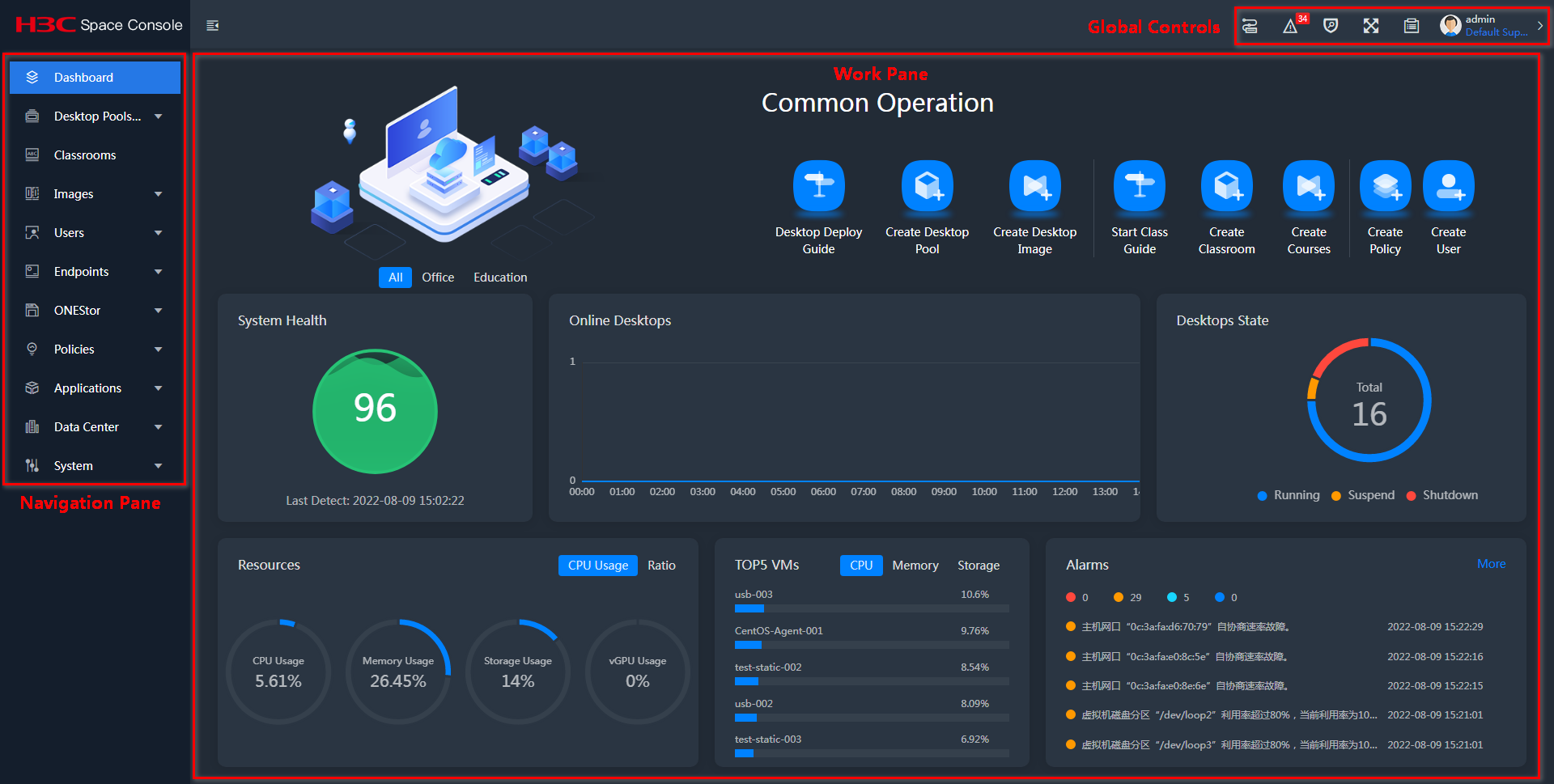
Global controls—Include help, health check, full-screen dashboard, notifications, task console, help center, remote assistant, version info, login info, language switching, password modification, and skin customization.
Navigation pane—Helps you manage resources in the system.
Dashboard—Provides a focused view of system running status, resource usage, and desktop usage. In addition, the dashboard displays deployment wizard for the office scenarios or education scenarios, class procedures, and common operations.
Desktop pools—Allows you to manage VDI, IDV, and VOI desktop pools and desktop pool groups. ARM hosts do not support IDV or VOI desktops.
Images—Allows you to manage desktop images, course images, and image storage. Desktop images are desktop templates used for bulk deploying desktops. Course images are templates used for bulk creating course desktops when students attend a class.
Classrooms—Allows you to manage classrooms.
Users—Allows you to manage end users (local, domain, and LDAP users) that log in through a client to use desktop resources, and admin users that perform system management and maintenance. In addition, you can view online users and the user denylist.
Endpoints—Allows you to manage VDI, IDV, VOI endpoints, and the endpoint denylist. ARM hosts cannot act as IDV or VOI endpoints.
Policies—Allows you to manage policy groups, global policies, and desktop detection policies.
Applications—Allows you to manage the app center, perform file distribution, software deployment, message delivery, image tools management, blind watermark decoding, cloud disk management, campus space deployment, cloud application management, and UniCloud cloud disks. ARM hosts do not support application-related functions.
ONEStor—Allows you to manage the integrated distributed storage software ONEStor. ONEStor virtualizes the native disks (SSDs and HDDs) of the hosts into a distributed storage pool. ARM hosts do not support ONEStor.
Data center—Allows you to manage virtual resources such as clusters, hosts, and VMs, and manage distributed storage (not available for ARM hosts), VM recycle bin, system images, and teaching storage.
System—Provides upgrade services, flavor configuration, command issuing (not available for ARM hosts), security settings, alarm management, advanced settings, reports, log, stateful failover (not available for ARM hosts), service configuration, and licensing features.